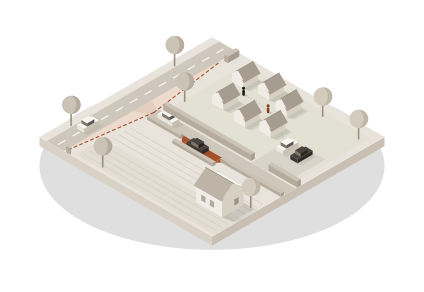
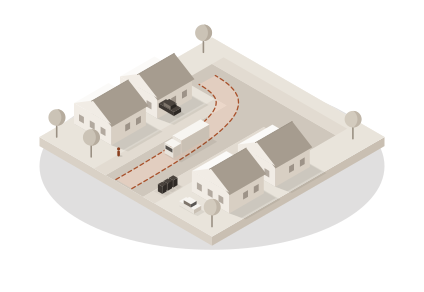
Equestrian uses sit comfortably in the countryside, and most councils support them in principle. The transport questions are rarely about the volume of traffic. They are about the vehicles: horseboxes and car-and-trailer outfits that are long, heavy, slow to manoeuvre and often driven by people who tow only occasionally, using narrow lanes that riders, walkers and farm traffic also depend on. Whether it is a private stable block, a livery yard, a riding school or a venue hosting shows and competitions, the same issues tend to come up. Planning for them early avoids most objections.
Know what the site will actually be used for
The type of equestrian use drives almost every transport question, so describe it precisely:
- Private stables for the owner’s own horses generate few trips, usually from the house or a single daily visit
- DIY and part livery can bring each horse owner to the yard once or twice a day, every day of the year, often at the start and end of the working day
- Riding schools and trekking centres have lessons that turn over through the day, with pupils, parents and instructors arriving and leaving at overlapping times
- Training, clinics and hire of arenas attract riders boxing in from elsewhere, so most visitors arrive with a horsebox or trailer
- Shows, competitions and events concentrate large numbers of vehicles into a few hours, on a handful of days each year
Councils often attach conditions limiting a stable to private use, or capping horse numbers or event days. If the intended use is commercial, or may grow, say so at the outset. An approval based on private use can be hard to stretch to livery or events later, and a change in how the site operates may need a fresh application with its own transport evidence.
Horseboxes, trailers and the site access
Equestrian traffic ranges from a car towing a single trailer to a horsebox with living accommodation that is as large as a rigid HGV. The access needs to work for the largest vehicle that will realistically use it. Officers will usually want to see:
- Visibility splays that reflect the real speed of traffic on the lane, measured with a speed survey where the speed limit is unlikely to be representative
- Swept paths for horseboxes and car-and-trailer combinations entering and leaving from both directions, without crossing the verge or the opposite side of the road
- Gates set back far enough that the longest outfit can pull fully off the highway while the gate is opened
- An access surfaced for the first few metres, so mud and loose material are not dragged onto the road
- Gradients that a loaded horsebox can manage, including pulling away from a standstill at the gate
Visibility often depends on hedges or banks the applicant does not control. Our note on visibility over land you don’t own explains the options, and the highway boundary can show how much verge is genuinely available.
The lane to the site
Many equestrian sites are reached along single-track lanes. The concern is less about trip numbers and more about what happens when a horsebox meets a tractor, a delivery lorry or another horsebox. Things to check:
- Lane widths along the route, and whether two vehicles can pass
- Passing places within sight of each other, and whether they are big enough for a horsebox
- Tight bends, humpback bridges, weight limits and low overhanging trees
- Where reversing would be needed if vehicles meet, and how far
Inspectors look at the whole route to the main road, not just the access. The Great Eccleston and Charlton Horethorne appeals show schemes failing on the lane even where the entrance itself was acceptable. New or extended passing places, verge cutting within the highway and a recommended route for horseboxes are common, practical answers.
Riders, walkers and horses on the road
Equestrian sites put more horses on the local roads. The Highway Code asks drivers to pass horses at no more than 10 mph and allow at least two metres, which on a narrow lane often means waiting. Councils and local riding groups will be interested in:
- How far riders need to travel on the road before they reach a bridleway or off-road route
- Whether that stretch includes blind bends, fast traffic or a busy junction
- Safe crossing points where riders need to cross a main road
- Whether a new or improved off-road link to the bridleway network is possible
A scheme that gets riders off the road quickly, or improves an existing crossing, can turn a potential objection into a benefit.
Deliveries, servicing and muck
Yards need regular servicing as well as visitors. Hay, straw, bedding and feed deliveries may come by tractor and trailer or by HGV, and muck heaps are usually emptied by a skip lorry or trailer. Farriers, vets, saddlers and dentists visit, and some yards need a horse ambulance or a vet’s trailer to reach the stables in an emergency.
The layout should allow these vehicles to get in, turn and leave in forward gear. Positioning the muck heap and the hay store where they can be reached without passing through the yard or the parking area keeps the site safer and avoids vehicles reversing onto the lane.
Parking and the yard layout
Parking is often where small yards struggle. Owners’ cars, staff, visiting instructors and horseboxes all need somewhere to go, and horseboxes need space to load and unload with the ramp down and a horse being led safely around it. Good layouts:
- Separate horsebox and trailer parking from cars, with enough room to turn
- Keep loading areas away from moving traffic and on level, non-slip ground
- Provide a clear route for horses between stables, arenas and the field that does not cross the main vehicle route
- Allow a fire appliance to reach the stable block, which matters where hay and bedding are stored
Local parking standards rarely mention equestrian uses, so the number of spaces usually comes from a first-principles assessment of how the site will operate at its busiest.
Shows, competitions and events
Events are where equestrian transport issues become most visible. A competition can bring dozens or hundreds of horseboxes to a rural site, many arriving early in the morning and leaving at the same time once the final class finishes. Questions the council, police and neighbours will ask include:
- Arrivals: can vehicles get off the road and onto the site quickly, without queuing back onto the lane or the main road?
- Parking: is there enough firm, well-drained ground for horseboxes, trailers and spectator cars, with a fallback if the field is waterlogged?
- Routing: are competitors sent along suitable roads, rather than the shortest route a sat nav suggests?
- Departures: will everyone leave together, and can the junction cope?
- Emergencies: can an ambulance, horse ambulance or vet reach any part of the site while the event is running?
For regular or larger events, an event traffic management plan sets out entrance and exit points, stewarding, temporary signs, parking layouts, timed arrivals by class and what happens in wet weather. Temporary signs on the highway usually need the highway authority’s agreement, and some councils’ safety advisory groups review larger events. Where events are limited in number by condition, show how the site will operate on its busiest day, not an average one.
Visitors and spectators
Facilities open to the public, such as a café, tack shop, viewing gallery or indoor arena used for clinics, can attract trips from people who are not riding at all. Either assess that traffic properly or make clear the facilities are ancillary to the equestrian use. Spectators at events often arrive in cars rather than horseboxes, so their parking needs to be planned separately.
Sustainable travel in a rural location
National policy accepts that rural sites offer fewer travel choices, and nobody brings a horse by bus. Officers still expect a reasonable effort where it applies: safe walking routes for staff or pupils from the nearest village, cycle parking, car sharing for livery owners, or a minibus for larger riding schools and events. On larger venues, a Travel Plan may be requested.
Construction
Building a stable block, indoor arena or menage involves deliveries of steel frames, stone and specialist surfacing, often by articulated lorry. On a narrow lane, a short Construction Traffic Management Plan covering routes, delivery times and where vehicles will unload often avoids a more onerous condition.
What to submit
Private stables may need little more than a site plan showing the access, visibility and parking. Livery yards, riding schools and event venues usually benefit from a Transport Statement. A strong submission typically covers:
- A clear description of the use, horse numbers, hours and any events
- Trip generation based on how the site will actually operate, including the busiest day
- Visibility and swept paths at the access for horseboxes and trailers
- The route to the main road, with any passing places or improvements
- Riders’ routes to the bridleway network
- Parking, loading and servicing within the site
- An event traffic management plan where shows or competitions are proposed
Highways refusals must still meet the national tests of an unacceptable impact on safety or severe residual cumulative impacts. For a well-planned equestrian scheme, the evidence usually shows they do not.
General information, not advice on a specific site. Policy and guidance correct as of October 2026.